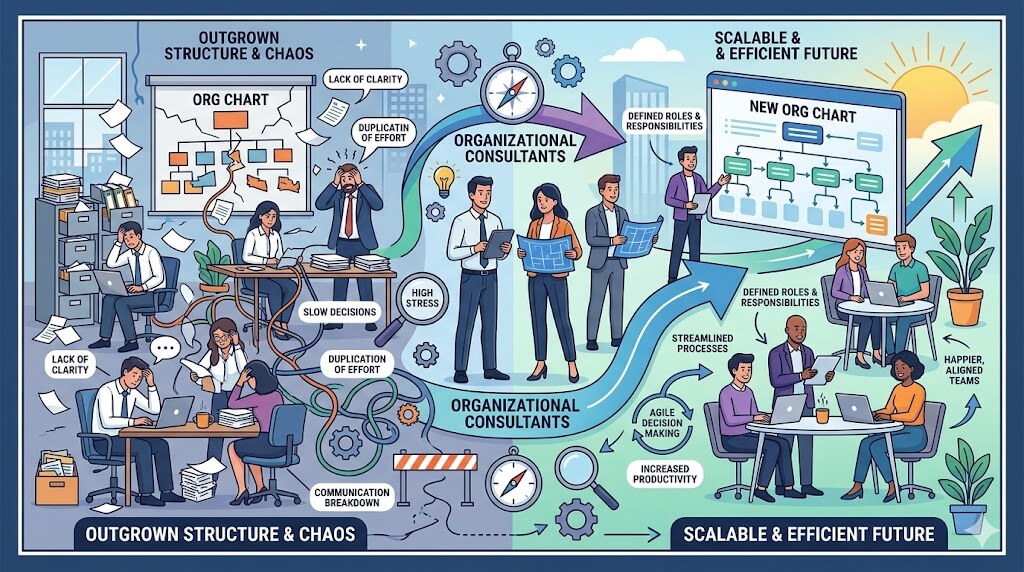
Most small business owners don't wake up one morning and decide they need an organizational consultant. The decision creeps up on them. The team grows from three people to fifteen and suddenly nobody knows who owns what. Decisions that used to take five minutes now require three meetings. Good employees start quitting and you can't quite explain why. Revenue is up, but somehow you're more stressed than when you were doing everything yourself.
That's the moment an organizational consultant earns their fee. Not when everything is on fire — but when you can feel the friction building and you don't have the bandwidth to step back and diagnose it. The right consultant helps you see what you're too close to see, redesigns the parts of your business that have outgrown your original setup, and gets your team aligned around how work actually flows.
This guide walks through what an organizational consultant actually does, the signs that your Las Vegas or Nevada small business has hit the point of diminishing returns on doing it yourself, and how to evaluate whether bringing one in is the right call.
The term "organizational consultant" gets used loosely. At the Fortune 500 level, it usually means change-management work tied to mergers or restructuring. At the small business level — which is who we'll focus on here — it means something more grounded: helping a business owner build the structure, roles, processes, and culture that match where the company actually is, not where it was when they started.
A good organizational consultant looks at four things:
The output isn't a 200-page report nobody reads. It's a clear set of changes you can implement — sometimes a new org chart, sometimes a process redesign, sometimes a series of difficult conversations the owner has been avoiding. The best consultants tell you the truth and then help you act on it.
Most small business owners are too close to their operation to see structural problems clearly. They feel the symptoms — exhaustion, turnover, missed deadlines — but they assume it's a personnel problem or a market problem. Often, it's neither. It's that the organization itself was designed for a smaller, simpler version of the business and hasn't evolved.
Here are the most common signals that an organizational consultant could help.
If your team can't move forward without your approval on small decisions, you don't have a team — you have helpers. This is the most common growth ceiling small businesses hit. The owner is the bottleneck because authority has never been formally delegated, and over time, employees stop trying to decide things themselves because they've learned the boss will overrule them anyway.
An organizational consultant helps you define decision rights, build a real management layer, and shift you from operator to owner — which is the only path to growing past your current ceiling.
When strong performers quit unexpectedly, the easy explanation is "they got a better offer." Sometimes that's true. More often, they left because the role was poorly defined, expectations kept shifting, or they could see the structural problems and didn't want to keep working inside them. Talented people don't tolerate organizational chaos for long — they have options.
A consultant can help you uncover the real reasons, fix what's driving people out, and design roles that retain the talent you spent so much time finding.
Revenue plateaus usually have structural causes, not effort causes. You can't sell your way out of an organization that's already at capacity. If your team is maxed out, your processes are duct-taped together, and adding more leads just creates more chaos, you've hit a ceiling that no amount of marketing budget will solve.
An organizational consultant identifies the constraint — usually it's a process, a role, or a system — and helps you redesign it so growth becomes possible again.
You may have written job descriptions years ago. But who actually does what right now? In most small businesses, the answer is wildly different from the formal structure. People have absorbed responsibilities outside their role. Critical functions sit with one person who's about to burn out. Two people both think they own something. Nobody owns something else important.
A consultant maps your real organization, exposes the gaps, and helps you redesign roles so they match how the business actually needs to operate.
If you spend your day in meetings, on Slack, answering questions, repeating yourself, and forwarding emails — that's a communication structure problem, not a productivity problem. As businesses grow from 5 to 15 to 30 employees, the informal communication patterns that worked at the start become a tax on everyone's time.
An organizational consultant helps you build the communication rhythms, documentation, and decision-making protocols that scale. The goal is for the right people to have the right information at the right time without requiring you to be the central hub.
If you've been telling yourself "I'll hire a manager next quarter" for three quarters in a row, something deeper is going on. Usually it's a mix of cost anxiety, fear of giving up control, and uncertainty about who to hire and what the role should actually do. A consultant helps you clarify what the role needs to be, what a successful hire looks like, and how to integrate them so they actually take work off your plate instead of adding to it.
The right consultant doesn't just deliver a deliverable and disappear. They give you capabilities and clarity you didn't have before, and they tend to pay for themselves within the first few months. Here's what good organizational consulting actually does for a small business.
You can't see your own business clearly. That's not a weakness — it's how human cognition works when you're inside something every day. A consultant brings pattern recognition from working with dozens of other businesses, which means they spot things you've been looking at for years and can't see anymore.
When roles, decisions rights, and processes are clearly defined, the business runs faster. Less rework, fewer dropped balls, less time wasted in "wait, who's doing that?" conversations. Most owners are surprised at how much velocity returns to the business once the structural confusion is cleaned up.
The end goal of organizational consulting is a business that doesn't require the owner to operate every day. That's what makes the business valuable, sellable, and sustainable — and it's also what gives you your life back. A consultant helps you build that, instead of staying trapped as the chief firefighter.
When roles are clear, when people understand how decisions get made, and when the culture is intentional rather than accidental, good people stick around. They also refer good people to you. A well-organized business is also easier to recruit into.
Most small businesses have 10–30% of their margin trapped in inefficiency — duplicated work, decisions made twice, processes that take three steps when they should take one. Cleaning up the organization usually frees up margin without any increase in sales. That's pure profit you weren't capturing before.
Pricing varies widely depending on scope and the consultant's experience. For Nevada small businesses, here's a realistic picture of what to expect.
The right way to think about cost isn't the invoice — it's the ROI. If a $10,000 engagement frees up 10 hours of your week, retains one key employee, and unlocks a revenue plateau, the payback is usually measured in weeks, not months. The wrong way to think about cost is to compare consultants on rate alone. Cheap consultants who don't deliver are expensive. Experienced consultants who actually move the needle are inexpensive even at higher rates.
Not every consultant is the right fit for a small Nevada business. Big-firm consultants often bring playbooks designed for companies 10x your size. Cheap freelancers may not have the depth or local context to actually help. Here's what to look for.
The dynamics of a 15-person Henderson business are nothing like a 1,500-person enterprise. You want someone who has actually worked inside small businesses, understands cash-flow constraints, and can give advice that's implementable next week — not in next year's budget cycle.
Nevada small businesses operate in a specific regulatory environment — state business licenses, county-level rules, industry-specific licensing in Clark and Washoe counties, no state income tax structuring, and a tourism-heavy economy that affects everything from staffing to seasonality. A consultant who actually knows the Nevada landscape can connect organizational decisions to the regulatory and tax realities you're operating inside.
The best small business consultants understand that the business and the owner are inseparable. Organizational problems are often leadership problems. Leadership problems are often personal problems wearing a suit. A consultant who can hold both — the practical org chart work and the deeper "why does this keep happening to me" work — will get you further than someone who only does spreadsheets and process diagrams.
Avoid open-ended engagements with no defined outcomes. Good consultants tell you upfront what you'll have at the end — a redesigned org chart, documented processes, a hiring plan, a 90-day implementation roadmap. Vague engagements usually produce vague results.
You're going to share uncomfortable things with this person — financial pressure, partnership tension, doubts about employees, your own limitations. If you don't trust them in the first conversation, you won't trust them when things get hard. The relationship matters as much as the resume.
Waiting until everything is on fire. The best time to bring in a consultant is when you can feel friction building but the business is still functioning. Waiting until you're in crisis means you're making expensive decisions under pressure and the consultant is doing damage control instead of strategic work.
Hiring for the wrong problem. Many owners hire a marketing consultant when the real issue is organizational, or a strategy consultant when the real issue is execution. A good first conversation should diagnose what kind of help you actually need before locking into an engagement.
Not committing to the implementation. Consultants don't change businesses — owners do. If you hire a consultant and then don't implement the recommendations, you've wasted the money. The most successful engagements happen when the owner is genuinely ready to change how they operate.
Treating it as a one-time event. Organizational consulting works best as a relationship, not a transaction. Businesses keep growing and structures keep needing to evolve. The owners who get the most value treat their consultant as a long-term advisor, not a one-time vendor.
At Silent G Consulting, we've spent 25+ years helping Nevada small business owners build organizations that actually run. We're not a big-firm operation with corporate playbooks. We work with the kind of businesses Nevada is built on — restaurants, retail, professional services, nonprofits, contractors, dispensaries, and entrepreneurs scaling from one location to several.
What makes us different is the whole-person approach. We know the practical side cold — formation, licensing, compliance, structure, hiring, operations — but we also know that growing a business is a personal journey, not just a strategic one. Vicki "Giana" Greco brings a legal background, decades of entrepreneurial experience, and a grounded perspective that helps owners get unstuck both in their business and in themselves.
We work with you to build the structure, roles, processes, and clarity your business needs to move past its current ceiling — and we stay involved long enough to make sure it sticks.
If you're ready to stop being the bottleneck in your own business, call Silent G Consulting at (702) 587-5652 or schedule a consultation to talk through where you are and what would actually help.
Social Media