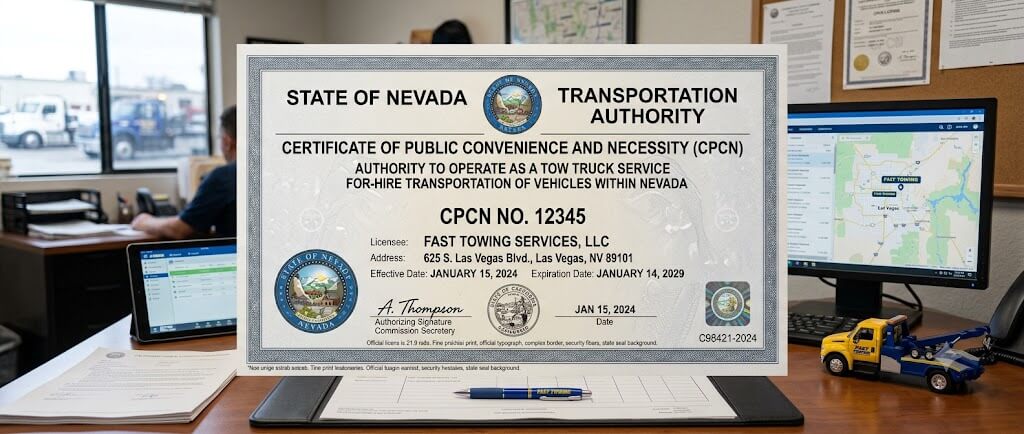
If you're planning to operate a transportation business in Las Vegas, securing a CPCN license is one of the most important first steps. A Certificate of Public Convenience and Necessity (CPCN) is issued by the Nevada Transportation Authority (NTA) and is required for most carriers transporting passengers, household goods, or providing towing services within the state. :contentReference[oaicite:0]{index=0}
Whether you're starting a limousine company, household goods mover, tow car operation, or other regulated transportation service, understanding the CPCN process can save you months of delays and thousands in avoidable costs.
A CPCN, or Certificate of Public Convenience and Necessity, is the official authority granted by the Nevada Transportation Authority that allows a carrier to legally provide regulated transportation services within Nevada. Under NRS Chapter 706, businesses must hold a CPCN, or qualify for an exemption, before transporting passengers or household goods within the state. :contentReference[oaicite:1]{index=1}
The CPCN demonstrates that the carrier meets the NTA's financial, operational, insurance, and public interest requirements before being allowed to serve the public.
Most regulated transportation operators in Nevada must obtain a CPCN before beginning service. Common business types that typically require a CPCN include:
Some limited operations may qualify for an exemption under NRS 706.735 through NRS 706.745. Determining whether you need a full CPCN or qualify for an exemption is one of the first steps in the process. :contentReference[oaicite:2]{index=2}
Before applying for NTA authority, most operators establish a formal business structure such as:
This provides liability protection and creates the legal foundation required for licensing, banking, and insurance.
The CPCN application differs depending on the type of service you intend to provide. The NTA reviews applications based on the specific operating authority requested, including passenger, household goods, towing, charter, or special services. Selecting the wrong authority type is one of the most common reasons applications get returned. :contentReference[oaicite:3]{index=3}
The CPCN application is a detailed packet that includes:
Reviewed or audited financial statements prepared by a CPA can help expedite the review process for certain authority types. :contentReference[oaicite:4]{index=4}
All regulated carriers must maintain insurance coverage that complies with NAC 706.191 minimums. Insurance must be in place before authority is granted, and coverage must be maintained for the life of the certificate. :contentReference[oaicite:5]{index=5}
CPCN applications are filed at the NTA's Las Vegas or Reno office along with the required filing fee and estimated publication costs. The NTA accepts checks, cash, and money orders. Email submissions are not accepted. :contentReference[oaicite:6]{index=6}
Once an application is accepted, the NTA publishes public notice of the proposed authority. Interested parties have an opportunity to file a protest or Petition for Leave to Intervene. If protests are filed, the matter may proceed to a public hearing before the Authority's commissioners. :contentReference[oaicite:7]{index=7}
After review and any required hearings, the Authority issues a final order. Once all compliance conditions are met, including insurance, tariff approval, and vehicle registration, the CPCN is officially issued and the carrier may begin operating.
The timeline varies depending on the type of authority, completeness of the application, and whether protests are filed. Straightforward applications may move through review in a few months, while contested or complex applications can take significantly longer. :contentReference[oaicite:8]{index=8}
Working with an experienced consultant who knows the NTA's filing requirements can significantly reduce delays caused by incomplete documentation or formatting errors.
Costs include the NTA filing fee, publication costs for the public notice, insurance premiums, and any professional fees for attorneys, CPAs, or consultants. Additional costs may apply if a hearing is required or a court reporter is needed. :contentReference[oaicite:9]{index=9}
Total startup investment varies widely based on fleet size, vehicle type, storage requirements, and insurance coverage levels.
The Nevada Transportation Authority has offices in both Las Vegas and Reno. The Las Vegas office handles applications and filings for Southern Nevada carriers and can be reached at (702) 486-3303 during regular business hours. :contentReference[oaicite:10]{index=10}
The CPCN application process is detailed, document-heavy, and unforgiving when it comes to formatting and exhibit requirements. A single missing exhibit or improperly prepared financial statement can push your launch back months.
Silent G Consulting helps transportation businesses across Nevada prepare CPCN applications, organize required exhibits, structure financials to meet NTA standards, and navigate the protest and hearing process. Whether you're launching a new company or expanding an existing certificate, we help you avoid the costly mistakes that derail first-time applicants.
If you're planning to start or expand a regulated transportation business and need help with your Nevada Transportation Authority CPCN application, insurance compliance, tariff preparation, or business setup, contact Silent G Consulting today.
A CPCN, or Certificate of Public Convenience and Necessity, is authority issued by the Nevada Transportation Authority that allows approved carriers to provide regulated transportation services within Nevada. :contentReference[oaicite:11]{index=11}
CPCN licenses for regulated motor carriers are issued by the Nevada Transportation Authority under NRS Chapter 706. :contentReference[oaicite:12]{index=12}
Transportation Network Companies (TNCs) such as rideshare platforms have their own application path through the NTA, separate from a standard CPCN. Individual drivers typically operate under the TNC's authority rather than holding their own CPCN. :contentReference[oaicite:13]{index=13}
Certain limited operations may qualify for exemptions under NRS 706.735 through NRS 706.745. Exemption applications are available through the NTA and there is no filing fee for some categories. :contentReference[oaicite:14]{index=14}
Timelines vary based on application type, completeness, and whether the application is contested. Uncontested applications may move faster, while contested matters can extend significantly longer due to hearings and additional review. :contentReference[oaicite:15]{index=15}
Yes. We assist transportation businesses throughout Nevada with CPCN application preparation, compliance, tariff filings, and ongoing regulatory support.
Social Media