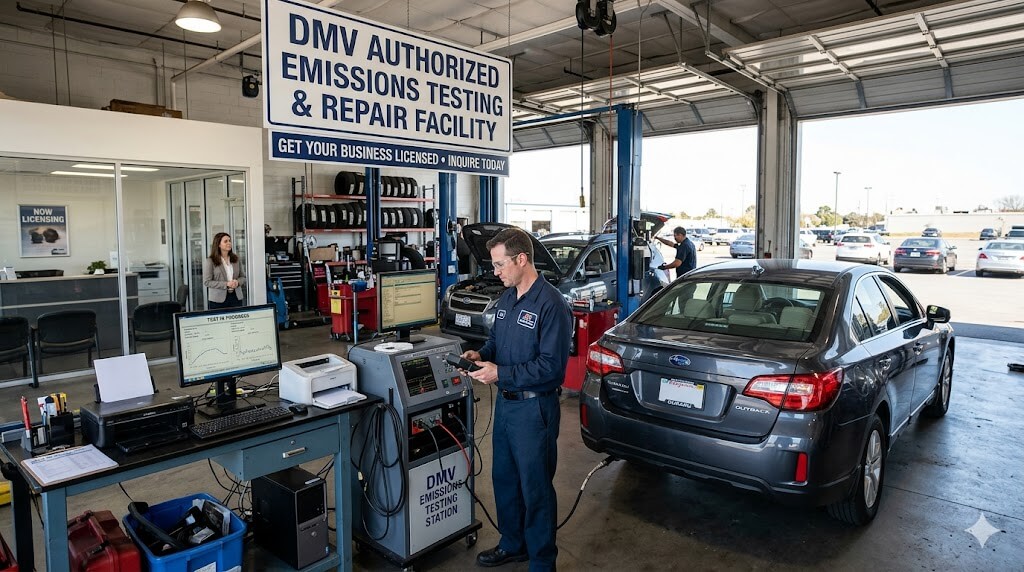
If you're looking to open an emissions testing station in Nevada — or add emissions inspection services to your existing auto shop — you'll need a DMV emissions license issued by the Nevada Department of Motor Vehicles Compliance Enforcement Division. It's one of the more involved business licenses in the state, with requirements that span facility standards, approved testing equipment, inspector certifications, surety bonds, fingerprint background checks, and ongoing compliance obligations.
Most applicants underestimate the process. It's not a single form and a fee. It's a multi-step licensing sequence that requires coordination between your business setup, your physical location, your equipment vendor, and the DMV's Occupational and Business Licensing (OBL) division. Miss a step or submit incomplete paperwork, and you're looking at weeks of delays before you can start testing vehicles and generating revenue.
This guide walks through the entire Nevada DMV emissions license process — who needs one, what types are available, what it costs, and how to get through the application without the runaround.
Nevada requires annual emissions testing for vehicles based in the urban areas of Clark County (Las Vegas, Henderson, North Las Vegas, Boulder City) and Washoe County (Reno, Sparks). That covers the vast majority of the state's registered vehicles. Every one of those vehicles needs to pass an inspection at a DMV-licensed emissions station before the owner can register or renew.
That mandatory testing creates consistent, year-round demand for licensed stations — and it's the reason the emissions inspection business remains one of the steadier automotive service models in Nevada.
If you want to perform those inspections, you need a station license from the DMV. If you want to also perform emissions-related repairs on vehicles that fail, you'll need a higher-tier license. And every person who physically operates the testing equipment needs their own individual inspector license on top of the station license.
The Nevada DMV issues several categories of emissions station licenses. The one you need depends on the scope of services you plan to offer.
This license allows your station to perform emissions inspections using OBD-II scanners (for 1996+ gasoline vehicles) and tailpipe testing equipment (for older vehicles). You can test vehicles and issue passing or failing Vehicle Inspection Reports (VIRs), but you cannot perform emissions-related repairs under this license. This is the entry point for most new emissions businesses.
A 2G license allows your station to both test and repair vehicles for emissions-related issues. This is a significant advantage because vehicles that fail in Clark County must be repaired at a 2G-licensed station to qualify for a waiver if the vehicle still can't pass after repairs. That regulatory requirement funnels repair work directly to 2G shops, making this license considerably more valuable than a test-only 1G.
If you want to test light-duty diesel vehicles (up to 14,000 lbs GVWR), you'll need diesel-specific equipment and licensing. Diesel testing uses a dynamometer and opacity meter rather than OBD-II, and the equipment requirements are more substantial. There are fewer diesel-certified stations in Nevada, which means less competition but higher startup costs.
Fleet stations are licensed to inspect motor vehicles for businesses that maintain their own vehicle fleets. This is a more specialized license typically pursued by large companies with enough vehicles to justify in-house testing.
Getting licensed involves satisfying requirements across several categories simultaneously. Here's what the DMV expects.
You'll need a registered business entity in Nevada — an LLC, corporation, or sole proprietorship with an active state business license and a local city or county business license. Your physical location must be a permanent, enclosed building with enough space to house the testing equipment and safely accommodate vehicles during inspections.
The DMV requires your station to maintain minimum business hours of 8:00 AM to 5:00 PM, Monday through Friday. If you're a single-inspector operation, you're required to post a notice whenever you step away during those hours.
The core application is the Business License Application Packet (OBL 335), which you submit to the DMV's Occupational and Business Licensing division. The packet includes:
Every principal listed on the application goes through a fingerprint-based criminal background check. Felony convictions, certain misdemeanors, and outstanding child support obligations can all affect your eligibility.
Nevada requires a $1,000 surety bond for emissions inspection stations. The bond guarantees that your station will comply with all applicable Nevada Revised Statutes (NRS 445B) and Nevada Administrative Code (NAC 445B) provisions. Annual premiums for this bond typically start around $40 depending on your credit, making it one of the more affordable bonds in the vehicle industry licensing space.
Your station must be equipped with DMV-approved emissions testing hardware. For gasoline vehicles, that means a certified OBD-II scan tool and, for older vehicles, a certified exhaust gas analyzer. For diesel testing, you'll need an approved dynamometer and opacity meter from manufacturers like Worldwide Environmental Products, Mustang, Superflow, Wager, or Bosch.
The equipment must connect to the state's Vehicle Information Database (VID) — the central system where all test results are recorded and transmitted electronically to the DMV. You'll need to complete an Application for Participation (EC-27) to get your VID access credentials set up.
You must carry automobile liability insurance coverage and provide a certificate of insurance to the DMV. The specific requirements are outlined in the DMV's insurance information sheet (OBL 273).
A station license alone doesn't let you test vehicles. Every person who operates the emissions equipment must hold their own individual inspector license issued by the DMV. Your station must employ at least one full-time licensed inspector at all times.
To become a licensed 1G emissions inspector in Nevada, you must meet the following requirements:
After all documentation is submitted and your background check clears, you'll schedule a practical examination at a DMV Emissions Lab. The practical consists of performing two complete emissions inspections — one tailpipe test and one OBD-II test — without error. You must pass on the first attempt or wait before retaking.
A 2G inspector license requires everything above plus an additional 12 hours of approved training from providers listed on the DMV's approved training list (EC-079). Approved providers include AC Delco instructor-led courses, Carquest instructor-led courses, and others. Alternatively, you can satisfy the training requirement with a current ASE L-1 certification exam taken within 12 months of your renewal date.
The total cost to get licensed varies, but here's a realistic breakdown of what to expect:
When you factor in equipment, facility buildout, insurance, and licensing fees, most new emissions station owners should budget in the range of $15,000 to $50,000+ depending on the scope of services and whether diesel testing is included.
The DMV emissions licensing process has more moving parts than most Nevada business licenses. Here are the issues we see most often.
Incomplete OBL-242 forms are one of the most frequent causes of delays. The personal history questionnaire requires a full five-year employment history with no gaps, complete addresses, zip codes, and phone numbers for every reference and employer. Leaving blanks or writing "N/A" where specific information is required will get your packet returned.
Fingerprint rejections happen more than applicants expect. If prints are unclear or incomplete, you'll need to resubmit and wait for another round of processing.
Equipment procurement timing is another common bottleneck. Ordering, installing, and certifying your emissions testing equipment takes time, and the DMV won't finalize your station license until the equipment is in place and connected to VID.
Forgetting the local business license is surprisingly common. Your city or county business license must be obtained before or alongside your DMV emissions license — the DMV requires a copy as part of your OBL 335 packet.
The Nevada DMV emissions licensing process involves multiple agencies, overlapping paperwork, background checks, equipment certifications, and timing dependencies that can drag out for weeks or months if you're navigating it alone. At Silent G Consulting, we handle the entire process from start to finish — business formation, local licensing, the OBL 335 packet, surety bond coordination, and follow-up with the DMV's Compliance Enforcement Division.
We've helped auto shops, independent mechanics, and new business owners across Clark County and Washoe County get their emissions station licenses without the back-and-forth delays that come from incomplete applications or missed requirements.
If you're ready to get your DMV emissions license and start testing vehicles, call Silent G Consulting at (702) 587-5652 or schedule a consultation to get started.
Social Media